






Polar Controversy Literature Part 7: 1913: The North Pole and Bradley Land
Written on May 18, 2026
The first book advocating Dr. Cook as the true discoverer of the North Pole was published in April 1913. It was the work of Edwin Swift Balch.
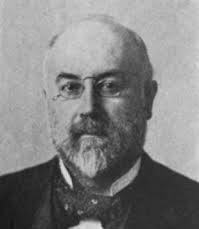
Balch was by no means a person of no standing.
Born in 1857, he was the son of a famous Philadelphia lawyer, and a lawyer himself, though he did not practice. Instead he devoted his life to scholarly scientific pursuits and to the arts. A Harvard graduate, he was a member of many learned societies including The Association for the Advancement of Science, The Franklin Institute, the American Philosophical Society, as well as both the American and Royal Geographical Societies. Although he climbed several mountains in Europe during his youth, reports on the internet that say he was himself an Arctic explorer are incorrect. He never visited either polar zone, although he followed polar exploits avidly.
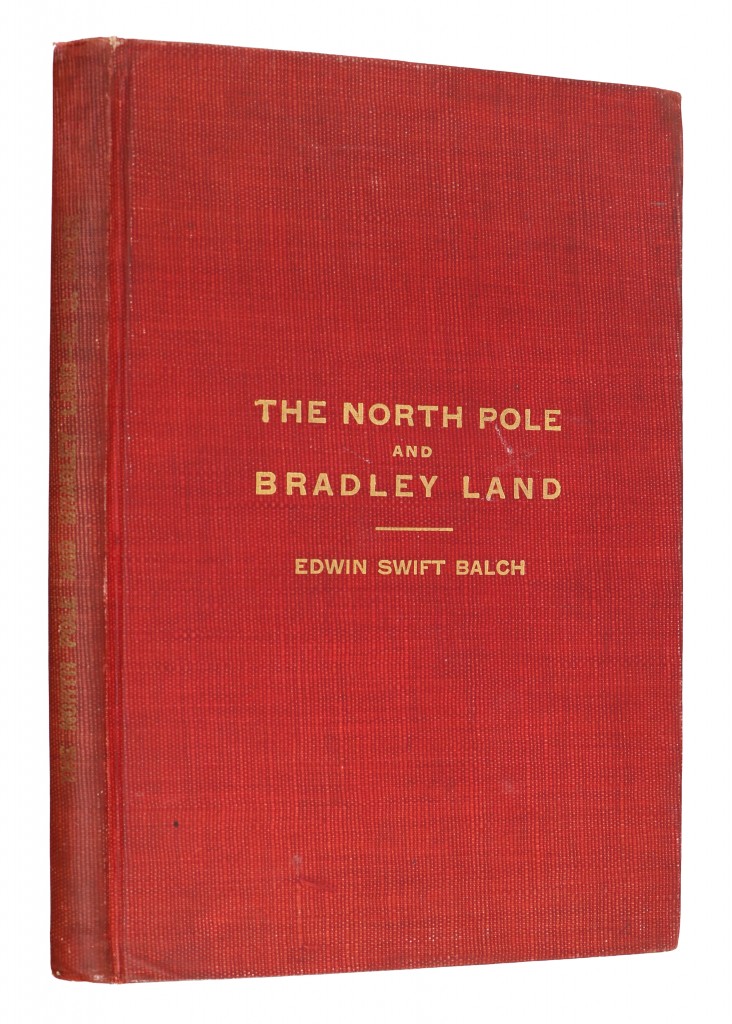
By the time The North Pole and Bradley Land was published, he had already authored and published at his own expense books on mountain climbing, glaciers, and ice caverns. He also published one on Antarctica in 1902, which was thought well enough of that he had the honor of having a mountain on the Antarctic Peninsula named for him by the French Antarctic explorer, Jean Charcot. With such a record, many were puzzled by his easy acceptance of Cook’s claim.
An article about his north pole book appeared in the NY Tribune shortly after its publication outlining his basis for belief in Cook’s veracity. The article was reprinted as part of the new material included in the third edition of Cook’s My Attainment of the Pole in 1913.
In his 82-page book’s examination of Cook’s claim, he all but summarily dismissed Cook’s lack of proof in the form of adequate astronomical observations, the arguments over whether or not he falsely claimed to have been the first to reach the summit of Mount McKinley in 1906, and his polar claim’s rejection by the Konsitorium of the University of Copenhagen of the evidence Cook sent in support of it as having no proof whatever of his having been at the North Pole on April 21, 1908, saying that none of these proved he had not been there.
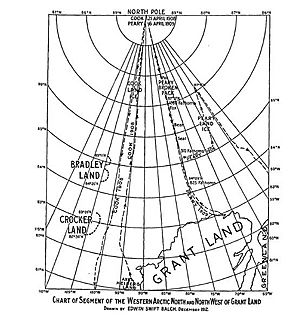
Instead he summed up his basis of belief that Cook’s claim was genuine by way of a comparison of the narratives of first, Cook, and, coming after him, Peary: “To solve such a problem as that of who discovered the North Pole, this comparative method seems to the writer the only on available,” Balch wrote. “It is not a matter of belief, it is a matter of comparison and reasoning. It is not the evidence which Cook produces which in itself alone could prove Cook’s claims. It is the geographical evidence offered by both Cook and Peary which, when carefully compared, affords, in the writer’s judgment, the only means of arriving at a conclusion. It is Peary’s statements and observations which prove, as far as can be proved at present, Cook’s statements.”
In other words, because Peary’s narrative corroborated Cook’s closely, and because Cook could not have known conditions at the North Pole, or along the route to it beyond the farthest North of the Duke of Abruzzi except by actual observation, he must indeed have been there. Apparently, Balch never considered the possibly that either both claims were hoaxes, or that Peary, having never been to the Pole himself, might have made his statements after reading Cook’s already published descriptions, and avoided any conflicts with Cook’s account.
Balch, even though his text showed his unwillingness to consider Cook’s total lack of evidence beyond his bare word as a factor, he claimed to be non-partisan. However, in a letter to the Tribune, he said, “I have tried to look at it as if this were the year 2013, and all of us in heaven. . . . It is only a question of time till Dr. Cook is recognized as the discover of the North Pole”
In 1914 he published another Cook advocacy book titled Mount McKinley and Mountain Climbers Proofs, arguing again that Cook’s descriptions of his climb were too similar to the mountain’s credited conqueror, The Reverend Hudson Stuck, to be imaginary. And once again, he refused to consider important evidence to the contrary. When Belmore Browne offered to show Balch his own pictures made in 1910, which he believed proved Cook’s photograph that he claimed showed his climbing partner atop the mountain’s summit, Balch angrily rejected Bowne’s offer, showing he didn’t have an open mind on the subject.
Though The North Pole and Bradley Land was published in 1913, there was evidently a later printing. The author’s copy has letters dated in 1916 as a postscriptum concerning several publications listing Dr. Cook as a co-author of The North Pole and Bradley Land, in which Balch’s expressed his displeasure with this error.
And indeed, Balch’s interest in the question of Cook’s claim continued beyond the publication of his two books related to it. Balch’s papers are held at the University of Virginia. Some of the materials they contain indicate that Balch encouraged, or perhaps even financed, the 1914 attempt to reach Bradley Land by Rudolph Franke, who had spent the winter with Cook at Annoatok in far Northern Greenland and traveled three days with him on his polar attempt in 1908. Among Balch’s papers is the sad diary of that failed attempt.
On January 28, 1915, Balch appeared before the Education Committee of the U.S. Congress and argued for Cook’s priority on McKinley and at the Pole along the same comparative basis he had used in his books.
Late in life, however, he came to at least consider that there was a way Cook claim could be disqualified. In an article that appeared in The Independent for November 28, 1925, entitled “Polar Controversies. II. Cook’s Claims,” Balch agreed with the British polar expert, J. M. Wordie, that “the existence of non-existence of ‘Bradley Land’ is the touchstone for testing Dr. Cook’s claims to have reach the North Pole. If land does not exist, his case is demolished forever. A . . . judgment on Cook should therefore be reserved till his statements have been confirmed or refuted.”
Bradley Land does not exist.
All of Balch’s books were published at his own expense and distributed by him to numerous libraries. Although, as has been noted, he was well respected, neither of his books touching on the Polar Controversy ever had much influence on other authors’ arguments concerning it. But in 1913 a privately published book that would was even then already in preparation, though it would not appear for four more years. It, too, would be donated to many libraries, but unlike Blach’s own, it would become a large factor in putting finish to Balch’s assurance that “It is only a question of time till Dr. Cook is recognized as the discover of the North Pole.”
Filed in: Uncategorized.