






Polar Controversy Literature Part 10: 1920: Has the North Pole Been Discovered? Volume II
Written on August 5, 2026
But Has the North Pole Been Discovered? was not Hall’s last word on the subject. In 1920 he published a paperbound supplement to the book which he styled as “Volume II,” which attempted to account for developments since his book’s publication. In it he devoted 52 of its 62 pages to subjects related to the “Eskimo Testimony.”
Despite its slightness, which he described on its title page as “a review of allegations of facts, which have come to light since Volume I was printed,” Hall claimed “these interesting allegations supply the links, which complete the chain of evidence, regarding the alleged testimony of Cook’s Eskimos.” The new book consisted of two chapters and an epilogue. The first was devoted to MacMillan’s article published in the February 1918 number of The Geographical Review.
Hall noted all of the discrepancies between MacMillan’s article and the statement allegedly made by Cook’s companions and published by the Peary Arctic Club in 1909, which was signed by MacMillan and other members of Peary’s expedition, who attested that it was a true representation of the statements of Etukishuk, Ahwelah and Etukishuk’s father, Panikpah. After comparing that statement with the one published in 1918, Hall concluded that it was impossible to reconcile the contradictions between the testimony of 1909 and that of 1917 as competent or consistent evidence.
The second chapter was concerned with an article entitled “Solving the Problem of the Arctic,” published by the arctic explorer Vilhjalmur Stefansson in the October 1919 issue of Harper’s Magazine. Although he never stated it outright as his intent, the “problem” Stefansson meant to solve was whether or not Frederick Cook actually went to the North Pole in 1908.
On a map showing graphically the falsity of the claims about Cook made by Stefansson, Hall also drew in a route for Cook that he felt corresponded to MacMillan’s 1918 article, but was completely different from the one that appeared on the map allegedly drawn by the same two Inuit in 1909. Instead of traveling out to, and then down the western coast of Meighen Island, as they had shown there, MacMillan’s letter seemed to indicate that they had continued directly down the western coast of Axel Heiberg Island to Cape Levvel before crossing over to the east coast of Amund Ringnes Island.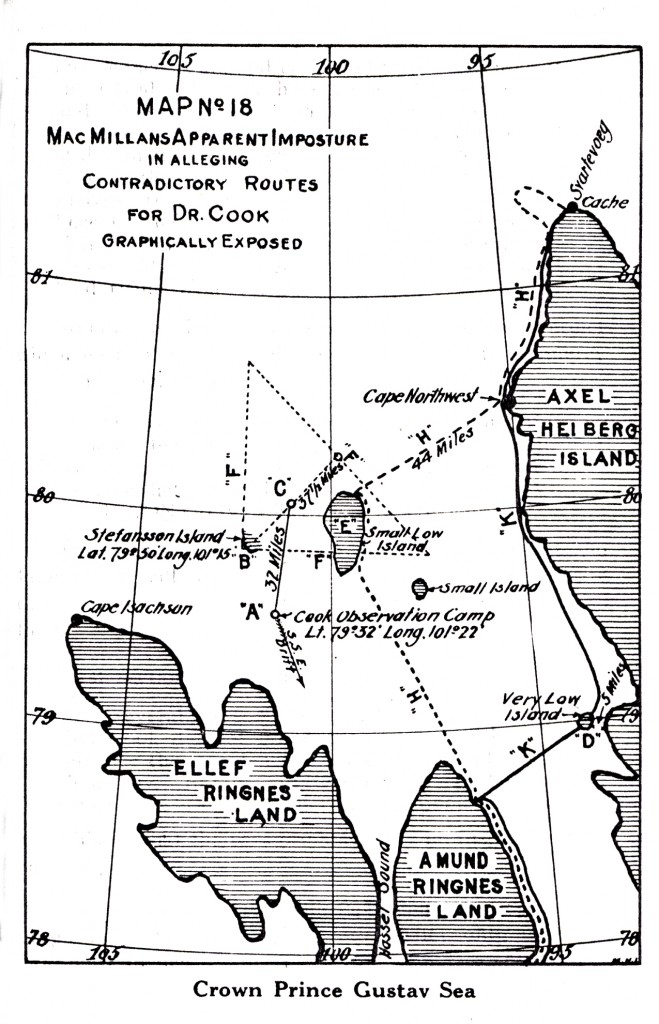
Off what appears to be Cape Levvel on Hall’s map, he places the “very low island” described in MacMillan’s 1918 text as lying at the 79th parallel. No such islands are shown on modern maps. However, Hall’s map is very sketchy and lacking in detail, being based on Sverdrup’s field maps.
MacMillan’s small low island can’t be Meighen Island, which lies a full degree (60 nautical miles) farther north than the island sketched in by Hall on his diagrammatic map, and 25 miles across the Sverdrup Channel at its nearest point to Axel Heiberg Island, whereas MacMillan’s 1918 statement describes his island as only 5 miles from it. These facts minimize the chances of these inconsistencies between the two reports being typographical errors on MacMillan’s part.
As a result, Hall justly dismissed the various statements made by Cook’s Inughuit as conflictual, and therefore without merit as evidence of the truth of the matter one way or the other. In Stefansson’s case, Hall rightfully recognized his 1919 article as a cunning attempt to undermine Cook’s credibility, which Stefansson continued to attempt to do in the suppressed chapter of his later book and in his ongoing correspondence with any author who took up the matter for decades to come, despite his continual claims throughout of his position being one of fair-minded neutrality.
In the Epilogue to Volume II, Hall declared it would be the last he would write on polar subjects, but he was not quite true to his word. In 1935 an essay dealing with the murder of Ross Marvin was included in W. Henry Lewin’s book, The Great North Pole Fraud, but it has no bearing on the present discussion. Hall used his epilogue to sum up his conclusions on the matter: “I have shown in this work that the stories of Peary and of others about Cook are apparently impositions and forgeries, and I leave the evidence I have produced in proof of it, to be refuted, if anyone can do it. . . . Eliminating the alleged eskimo testimony eliminates the only charge ever made against Cook and leaves his claim undisputed.”
Filed in: Uncategorized.