






Polar Controversy Literature Part 4: 1911: My Attainment of the Pole
Written on November 10, 2025
This is the fourth in an occasional series that will examine the published literature in book form relevant to the details of the Polar Controversy. These books will be discussed in the order they were published.
The quintessential book of the Polar Controversy is My Attainment of the Pole, Dr. Cook’s narrative of his 1908-09 expedition, and his comments upon his controversy with Peary. It appeared in August 1911. It has already been treated to a detailed analysis elsewhere on this site (see under the “Artifacts” section), but deserves a few more comments here.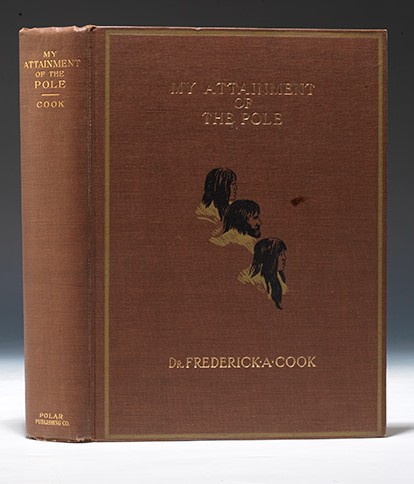
It went through three editions, the first published by Cook’s own Polar Publishing Co., the last two published by Mitchell Kennerley, amounting to more than 60,000 copies. Between the years 1912-1916, as Cook toured as a Lyceum and Chautauqua lecturer, he sold the book at cost at all his appearances and gave many other copies away for many years after that. The book won innumerable friends for Cook, who through its pages were convinced Cook had reached the Pole and had been cheated of his glory by a moneyed conspiracy.
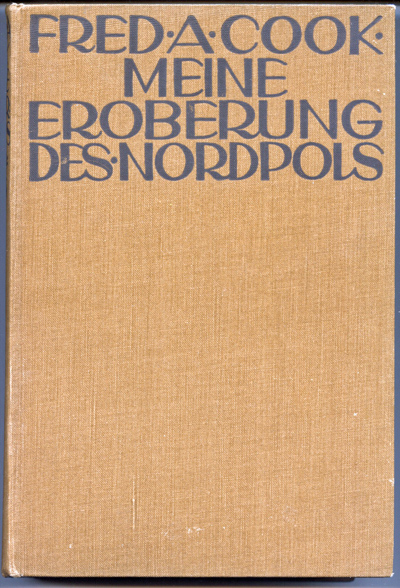
Many who read the book felt as reviewers had in Germany when the book was issued there in translation as Meine Eroberung des Nordpols by Alfred Janssen in 1913:
“The book shows the clever researcher on the difficult way to the Pole and on his return over the limitless wastes of icy water with its inhuman difficulties. Everything is told in such a self-effacing and sympathetic way that we can rejoice in its simple heroism.”
“The contents of the book have held us chained from beginning to end. The descriptions are simple and modest and so natural. It can be no lie what this man lets us experience, and even if it is a lie, it has eared a place in every library.”
His readers also sensed what another reviewer, this time of Cook’s Hampton’s series, did when he praised Cook’s abilities as a descriptive writer, “This is vivid and real. It is not imaginative literature. It is obviously descriptive of actual and unusual experience. As such the record is worth preserving, irrespective of the writer’s reputation for veracity.”
That was because Cook’s experiences as an explorer were real. He had personally encountered all the “inhuman difficulties” the book describes, even if he fell more than 400 miles short of the North Pole on his attempt to reach it.
Another attractive feature of the book is its treatment of the Inuit, who Cook, unlike Peary, sincerely admired, and to whose skills in adapting to the polar environment he gave full credit for his “success.” This homage is memorialized in the book’s dedication, “To the Pathfinders . . .”, and by the original edition’s cover, which despite its singular title, shows his own profile between those of the two Inuit who accompanied him, Ahwelah and Etukishuk.
Unlike Peary’s book, which makes no reference at all to the Polar Controversy, Cook’s has a significant amount to say in rebuttal to points raised against his claim to have beaten Peary to the pole by nearly a year. It also contains many arguments intended to show that his claim was defeated by manipulations of the press and bribes orchestrated by an “Arctic Trust” of Peary’s rich and influential backers, and to cast doubt on their and Peary’s characters.
The one question still left unanswered at the time the analysis referred to above was written, was just how much of My Attainment Cook wrote himself and how much of it was ghosted by T. Everett Harré.
When I did my annotated transcription of the diary Cook kept on his polar attempt (The Lost Polar Notebook of Dr. Frederick A. Cook, available on Amazon or eBay) that question was definitively answered. A very large part of the book’s narrative content appears in that notebook, written in the underground igloo in which he spent the winter of 1908-09 with his two Inuit companions. In fact, a surprising amount of the book appears in practically unaltered form there.
Therefore, his description of Harré’s original contributions as limited to “handling of certain purely adventure matter,” appears accurate, and Harré’s statement that he acted simply in the ordinary role of editor of Cook’s already written narrative also seems accurate. So, unlike Peary’s The North Pole, Cook’s book was not ghosted from interviews, but was closely based on an already existing manuscript written by Cook himself.
Unlike Peary’s book, which was translated into at least a half-dozen languages, Cook’s was only translated into German. This was because, he, although born in America, was a pure German by birth, and his story raised a certain amount of national pride that one of German blood had been the one to discover the North Pole, and therefore it found a sympathetic ear within his ancestral homeland.
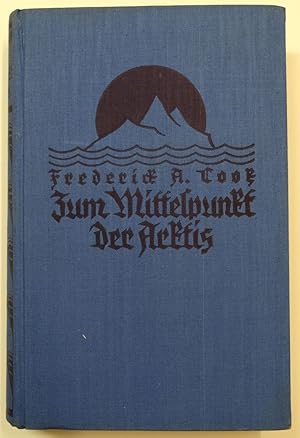
In addition to the full translation, in 1928 an abridged version under the title Zum Mittelpunkt der Arktis. Reiseberichte ohne die Pol-Kontroverse. (To the Center of the Arctic. The travelogues without reference to the polar controversy), edited by Erwin Volckmann, was issued by Westermann, Verlag. As indicated by the subtitle, the abridgment removed all references to Cook’s dispute with Peary, but retained the core narrative of his expedition.
Filed in: Uncategorized.