






Polar Controversy Literature Part 3: 1911: A Tenderfoot with Peary
Written on October 7, 2025
This is the third in an occasional series that will examine the published literature in book form relevant to the details of the Polar Controversy. These books will be discussed in the order they were published.
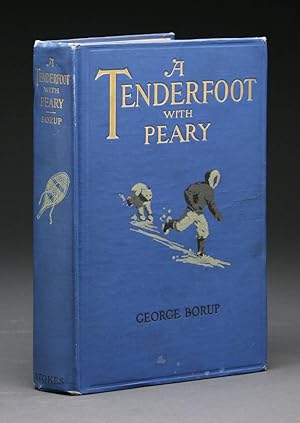
Peary always had a strict rule that no expedition member could write anything about his experiences until one year after his own official narrative had appeared. He apparently made an exception for George Borup. The North Pole was issued in September 1910, and Borup’s book was released in March 1911. Perhaps this was due to both being issued by the same publisher, Frederick A. Stokes, who may have seen advantages in “striking while the iron is hot” with Borup’s book before interest in the “discovery of the North Pole” faded. Or Peary may have felt that the character of Borup’s book would not be seen as a rival to his own.
Borup was a recent graduate of Yale (1907), and his book is a reflection of that and being the youngest “assistant” Peary took with him in 1908. It is shot through with humorous asides, Hully Gees, Holy Smokes, Gee-Whizes and other college slang. However, it also has many interesting insights into Inuit culture and the individual personalities of the various Inuit that Peary and Cook lived and worked with, that Peary’s book almost totally lacked. Although some of these vignettes are the subject for Borup’s humorous asides, they also show a respect for Inuit resourcefulness and character, which give the book some lasting value. For instance, he described their habit of swapping wives: “The habit of changing wives does not break up the love of man and wife, which is sorter like German separable verbs.”
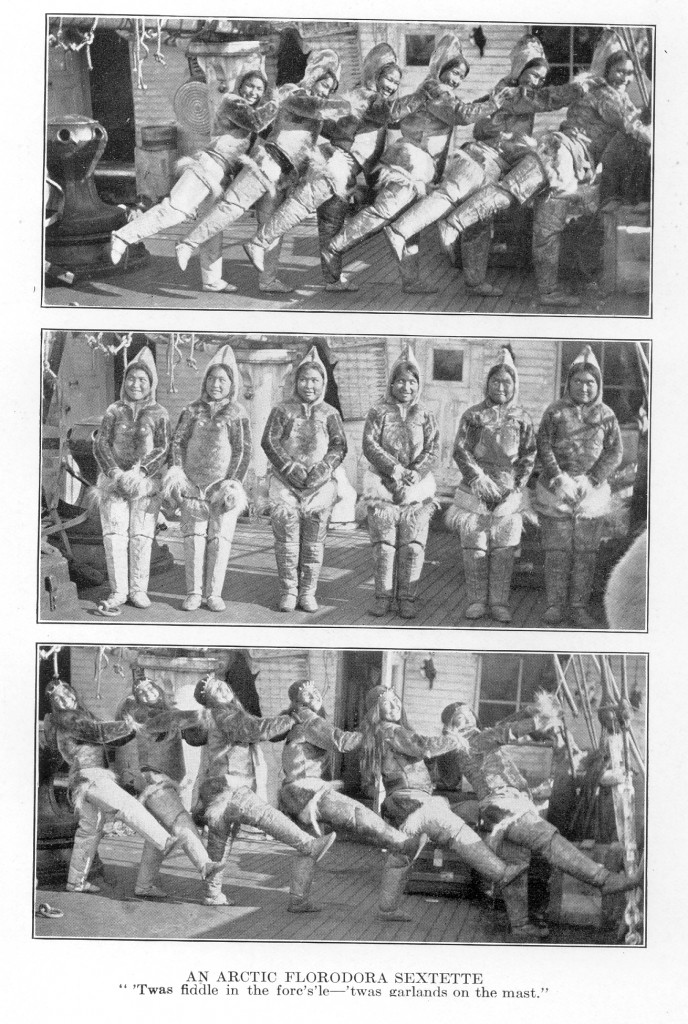
A page from Borup’s book. “Florodora” was a popular musical whose most memorable feature was a song and dance number performed by six gorgeous girls.
Looking beyond the hagiographic treatment of Peary it contains, the book’s content relevant to the Polar Controversy is still of subtle, if slight interest to connoisseurs of the subject. Borup was the third of Peary’s assistants to turn back on the polar journey, so he personally experienced many of the hard experiences needed to attempt to reach the North Pole, and although he mentions experiences of others who went farther, he gives no account at all of Peary’s experiences once the two had parted. These descriptions of Borup’s and others’ experiences on the polar journey, however, only add to the doubts expressed by Lewin that Peary’s own account of what he accomplished after leaving behind his last literate witness is doubtful in the extreme, it being so at odds with those recorded by Borup and others.
Borup describes the horrendous ice conditions encountered, and the backbreaking labor necessary to make forward progress. He also describes the drift of the ice, first west, then east, that made the outward trail hard to follow, and which was often completely lost, and remarks on the considerable open water encountered, which held his party up repeatedly. Because of these conditions, he estimates that it took three extra miles of travel to make ten miles progress north in a straight line. He repeatedly reports the sledges going to pieces, at one point smashing eight of them to gain 60 miles, the constant troubles had with the dogs, and the Inuit’s great fear of the sea ice and their malingering and reluctance to go forward to face its obstacles.
After his return to land, while on a trip to Cape Morris Jesup to take tidal measurements, he and Donald MacMillan received via Inuit messenger, a letter from Peary dated April 28, 1909, stating “Arrived on board yesterday. Northern Journey entirely satisfactory.” Their ecstatic reaction recorded by Borup shows that they immediately took this to mean Peary had reached the Pole, even though the long letter, which he reproduces in full, made no specific mention of doing so, or any reference whatever to his “satisfactory” experiences otherwise.
Borup’s book also contains a brief account of Borup’s version of what Dr. Cook’s two Inuit companions said about their experiences with him on his 1908 polar attempt, intended to cast doubt that he ever traveled more than two days northward before turning back (see the post on this blog for January 27, 2023). He also discusses what he considers further evidence of Cook’s failure to get far toward the Pole in the form of a description of Cook’s one surviving sledge, which he says could not possibly have made the full journey to the North Pole and back due to its relatively intact condition, albeit it had been cut down to half of its original size. In so doing, he actually reveals the shortcomings of Peary’s “clipper-built” sledges, made perfectly plain in his account of his portion of the journey (which Peary put great emphasis on as one of the major reasons he was able to reach the Pole by exceeding the performance of any other explorer’s attempt) by describing how they started to come apart quickly and regularly once the journey over the polar ice began.
Although there is little in Borup’s book that would directly cast doubt on Peary’s claim other than his descriptions of traveling conditions, which raise doubt on Peary’s ability to travel as fast as he said he did, correspondence in Peary’s papers shows that he had his lawyer, Charles Nichols, carefully go over Borup’s manuscript to make sure it would not add anything to the numerous questions being expressed in the press in reaction to conflicts and contradictions between Peary’s serialized narrative, as it had appeared in Hampton’s Magazine, and The North Pole.
By the breezy narrative contained in A Tenderfoot with Peary, Borup became the darling of the expedition. He was given a job at the American Museum of Natural History, became the protege of Edmund Otis Hovey, the Museum’s geological curator and editor of its journal, Natural History. Hovey favored him over MacMillan, to lead an expedition partially sponsored by the Museum to visit and map Crocker Land, which Peary claimed to have discovered at a distance while standing on the heights of Axel Heiberg Island in 1906. Borup was even in the process of courting Peary’s teenage daughter in 1912 when he drowned in a boating accident on Long Island Sound, postponing the start of the Crocker Land Expedition until 1913.
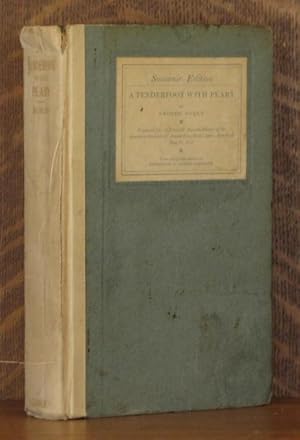
Borup’s book also exists in a “souvenir edition” prepared by Stokes for the 11th annual dinner of the American Bookseller’s Association held at the hotel Astor on May 11, 1911.
Filed in: Uncategorized.