






Polar Controversy Literature Part 2: 1911: Did Peary Reach the Pole?
Written on September 29, 2025
This is the second in an occasional series that will examine the published literature in book form relevant to the details of the Polar Controversy. These books will be discussed in the order they were published.
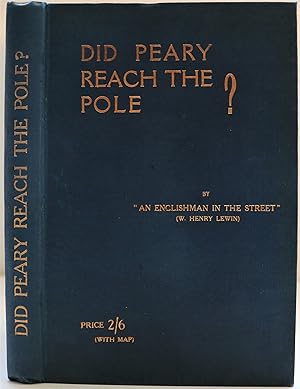
It took less than a year before the first book appeared doubting Peary’s claim with the questioning title, Did Peary Reach the Pole? It was published in England by W. Henry Lewin, who styled himself merely as “An Englishman in the Street,” but who was something of a professional skeptic on a number of topics in all of his privately published later writings.
Using Peary’s own narrative in The North Pole, and comparing it with those published by other explorers on similar journeys, particularly Nansen’s Farthest North, Lewin was the first to identify the major questionable features of Peary’s claim:
• The implausible enormous distances Peary said he covered during the last three “marches” toward the Pole after leaving Bob Bartlett.
• The incredible difference between the time he took to return to his ship from the Pole and the time it took Bartlett to do the same thing. Although Bartlett had a 266 mile head start on him, Peary would have beaten him back had he not paused to rest upon reaching land again.
• The impossible difference in Peary’s daily speeds when compared to other explorers’ on their attempts to reach the Pole via dog sledge.
• Peary’s lack of observations adequate to keep the straight line course to the Pole he claimed, especially the absence of any observations for longitude at any point along the journey, or any for compass correction.
• Peary’s claim that despite the record of all other polar journeys, including his own previous attempts, that there was no lateral movement of the ice for large portions of his entire journey.
• Peary’s failure to account for the added distance needed to cover detours to avoid leads and hummocks, which when added to the distance actually traveled, even by Lewin’s very modest estimates, made Peary’s timetable even more improbable.
Nevertheless, although Lewin’s answer to the title of his book was a resounding “NO,” he declined to say that Peary’s polar claim was a fraud because Peary was a “man physically and mentally of a high type.”
“No such charge as attempting to bluff mankind can possibly be made against a man of Commander Peary’s type. The original high intellectual calibre of the man, added to the greatness of a record developed and enlarged by twenty-five years’ experience in the Polar solitudes must be proof-positive against any such possibility. . . .No man who has been brought face to face in the soul’s communion with Nature in its wildest form over such a period, could be knowingly guilty of such an atrocity.”
Instead he attributed Peary’s failure to inadequate observations and the difficulties involved in determining positions with a sextant when the sun was at so low an elevation as Peary encountered in early April 1909.
In any case, in his introduction he stated that his motivation in writing the book was not to disparage Peary, but to suggest that the monumental doubts his narrative raised also raised the possibility that an English expedition could still capture the Pole for the British Empire’s own glory. At its conclusion, He excused the award of a special gold medal to Peary by the Royal Geographical Society as possibly due to “certain diplomatic considerations,” rather than the strength of his “proofs.” Whether Lewin was aware at the time he was writing that the inscription on the medal said that it was being awarded for “Arctic Explorations 1886-1909” rather than for discovering the North Pole, is not known.
Whether or not he actually felt Peary was guiltless in 1911, twenty-five years later Lewin would write another book on the same subject, and in the interim had found cause to eat every word of this earlier evaluation of Peary’s character.
Filed in: Uncategorized.